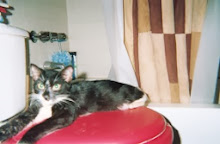
Thursday, June 16, 2011

Cat Thursday ~ Play Time!!

Lola, Hennessey and Addie & JoJo, respectively, playing Hide n' Seek!


Cat Thursday is hosted by Michelle at The True Book Addict. If you have a cute, fun photo of your cat, share it by posting it on your blog and linking it to The True Book Addict.

Wednesday, June 15, 2011

Wondrous Words Wednesday!

Wondrous Words Wednesday is a weekly meme hosted by Bermudaonion's Weblog where we share words that we’ve encountered in our reading. Feel free to join in the fun (please do!) Be sure to leave a link to your post over at Bermudaonion's Weblog.


All words are from Cutting for Stone by Abraham Verghese

"She'd always loved the story of Pasteur's discovery of microbes, or Lister's experiments with antisepsis.". (p.60)

1. Antisepsis (~ noun )
: Prevention of infection by inhibiting or arresting the growth and multiplication of germs (infectious agents). Antisepsis implies scrupulously clean and free of all living microorganisms


(This next sentence provides more info than you may care to know about part of the male anatomy!)


"And then she was thinking of the Frenchman's balls, of rugaeform folds, of the median raphe that separated one bollock from the other, of the dartos muscle, the cells of Sertoli." (p.87)

2. Rugaeform ~ noun
: I had difficulty finding a meaning for this word. wiseGEEK provided the clearest explanation:
: In anatomy “rugae” is a term which refers to the ridges formed by tissue which is naturally folded. Rugae can be found in a number of anatomical structures in the body. The arrangement of the folds can vary from person to person, causing the ridges to look different in different people. Folds in body tissue serve a number of important functions, ranging from protecting reproductive ability to ensuring that someone can eat comfortably

3. Raphe ~ noun
: a seam-like union between two parts or halves of an organ
: a connecting ridge of tissue

4. Dartos ~ noun
: a thin layer of vascular contractile tissue that contains smooth muscle fibers but no fat and is situated beneath the skin of the scrotum or beneath that of the labia majora

5. Sertoli ~noun
: a 'nurse' cell of the testes that is part of a seminiferous tubule.- called the 'mother' or 'nurse cell because its main function is to nurture the developing sperm cells through the stages of spermatogenesis (the process when primary germ cells divide into sperm)


"Much later that night, Mebratu and Ghosh palavered over cognac and cigars.". (p.271 )

6. Palaver ~noun; verb
: a conference or discussion; profuse idle talk, chatter
: a long parley, especially one between primitive natives and European traders, explorers, colonial officials, etc.

Tuesday, June 14, 2011

The London Train by Tessa Hadley

Title: The London Train
Author: Tessa Hadley
ISBN: 978-0062011831
Pages: 324
Release Date: May 24, 2011
Publisher: Harper Perennial
Genre: Literary Fiction; Contemporary Fiction
Rating: 3.5 out of 5

Publisher: Unsettled by the recent death of his mother, Paul sets out in search of Pia, his daughter from his first marriage, who has disappeared into the labyrinth of London. Discovering her pregnant and living illegally in a run-down council flat with a pair of Polish siblings, Paul is entranced by Pia’s excitement at living on the edge. Abandoning his second wife and their children in Wales, he joins her to begin a new life in the heart of London.
Cora, meanwhile, is running in the opposite direction, back to Cardiff, to the house she has inherited from her parents. She is escaping her marriage, and the constrictions and disappointments of her life in London. But there is a deeper reason why she cannot stay with her decent Civil Service husband—the aftershocks of which she hasn’t fully come to terms with herself.
Connecting both stories is the London Train, and a chance meeting that will have immediate and far-reaching consequences for both Paul and Cora.


My Thoughts: The London Train by Tessa Hadley is actually comprised of two shorter books, best thought of as novellas: first, The London Train and second, Only Children. Both are about middle-aged individuals, Paul in the former and Cora in the latter. Each are coping with troubling crises, trying to find their way. We learn the two novellas are loosely connected in Only Children. My reaction varied depending on where I was in the reading. I was confused, incensed, bored or intrigued while reading this book and I had some difficulty getting through The London Train novella because I didn't like the character, Paul. Now that I've finished reading and thought about it for a while, The London Train is a realistic, intriguing, well written commentary on human behavior.

Paul's widowed mother died in the opening pages of The London Train and, as her only child, Paul must finalize things at his mother's home and make arrangements for the funeral. It quickly becomes clear Paul is out of his element: "...he must be so careful to do the right thing, but it wasn't clear what the right thing might be." Yet when his wife, Elise, who Paul has called about his mother, offers to come and help, he says no. Ms. Hadley slowly, subtly, is letting us know what kind of man Paul is. He refers to his mother's death as "...the ordinary, expected, common thing..." and adds that it's a "...release from a burden of care." So it's really no surprise when, in the next paragraph, we learn "he had not visited her as often as he should." but this is understandable if regrettable and happens to many adult children of elderly, ill parents. Its when Paul admits "He had been bored, when he did visit", we feel We have no choice but to convict him being at best selfish, at worst, cruel.

Ms. Hadley has created, in Paul, a character that many of us might not want to associate with. He's very human, rationalizing his bad behavior. Who among us can deny that this is a universal trait? His honesty is probably what makes most of us uncomfortable, since most people take their less savory elements and sublimate them or flat out deny their existence. For example, while making love with Elise, Paul fantasizes about his pregnant daughter's 28-year old friend. He feels some shame about this middle-aged cliche, so what does he do? Does he focus on his wife while making love to her? No! Instead he tries conjuring up the woman he had an affair with a few years earlier! All of which he freely admits to himself.

Paul is an extremely flawed human being with a long list of repugnant qualities. And so it is to Ms. Hadley's credit that I wanted to continue reading The London Train. She has created some engaging secondary characters such as Pia, whose continued presence in Paul's life intrigued me. She is Paul's daughter from his first marriage, pregnant and living in an illegal sublet in London with her boyfriend. Paul doesn't know Pia very well and hasn't been a good father to her. Ms. Hadley very effectively shows us how Paul's egotism and self-centeredness colors his perception of others through his relationship with Pia. Paul's judged her harshly because while growing up Pia was very different than he was at her age. Instead of being obsessed with politics and ideas, Pia was "...anxiously shy, wrapped up in the tiny world of her friends and their fads, devoid of intellectual curiosity.". Rather than try to understand Pia, Paul condemned her for not being a mini version of himself, calling her "...stolid, sulky, unyielding...". Paul may be put off by Pia's quiet, reserved manner and facial piercings but admits that when he used to take her to visit her grandmother, Pia was patient and kind to her. This surprised Paul because he was irritated by his mother's behavior, especially her tendency to repeat herself. The result is he's unable to empathize with Pia or comfort her while she is upset about her grandmother's death. Instead, Paul's surprised she's affected so much.

It's difficult to understand why Pia allows Paul into her London life when he's been primarily absent until now. Through Paul and Pia, Ms. Hadley explores the complexity of father/daughter relationships. There's a powerful bond between them and Pia's willing to give Paul another chance to be the father she needs. She's facing motherhood, a new experience, and feels alone and uncertain. Paul's disinterest and ignorance of who Pia used to be enables her to let him in now.

As Paul feels unstable and uncertain about life after the death of his mother, caring for Pia gives him something to focus on. Paul, ever the self-centered male, envisions himself as Pia's rescuer. But we are willing to grant him this bit of selfishness if he's there for Pia. Ms. Hadley plants hope in our minds that Paul will be a better man. But then she cleverly and cruelly reminds us that people rarely change who they are as Paul makes another selfish, cruel decision without regard for the long-term consequences, something he's done before. We remember, with a gasp, a part of the story Pia doesn't know. We realize Paul's just is not there for Pia and probably never will be. Paul is a very real, very flawed human being with few redeeming qualities even in the face of his daughter's need.

In Only Children, we are introduced to Cora, a middle-aged woman going through a difficult time in her life. She, too, is flawed and, like Paul, makes a very bad choice without regard for its long-term effects. Unlike Paul, Cora struggles with the implications of her decision, almost destroying her life as a result.

Cora lives in Cardiff, Wales, in her childhood home bequeathed to her after her mother's death three years ago. Cora recently redecorated the house, resigned her teaching job, left her husband and their home in London. She has essentially begun a new life. Although Cora seems stiff, formal and uncomfortable when her best friend and sister-in-law Frankie comes to visit with her children, it's apparent that Cora isn't an unkind person but in the throes of a life crises and struggling to stay afloat. Frankie represents Cora's old life, one she's trying to break free of because she has too much pain and unhappiness associated with that time.

Cora is a much more sympathetic character than Paul but, like him, she rationalizes her behavior. Ms Hadley writes compellingly of Cora's breakdown following her mother's death and the intense pain that caused her to shut down. As Only Children progresses, we understand that Cora is over-whelmed by life. She and her husband were trying to have children in the years before her mother's death and Cora had been undergoing fertility treatments. Her inability to communicate with her husband or anyone else and intense feelings of failure resulted in Cora making a decision she never could have imagined.

Ms. Hadley keeps us interested in an otherwise "regular person's" life with her ability to throw curve balls. She does this effectively with Cora, snapping her out of her self-centered whirl pool of pity. Throughout Ms. Hadley shows she is well aware of the exigencies of real life and the impact of choices and events, large and small, on human beings. She tells compelling stories, writes very real characters without the need for embellishment or extraordinary occurrences, and keeps you reading whether you like a character or not, which is a talent that deserves attention.

Thank you to TLC Book Tours and Harper Perennial for a copy of The London Train and the opportunity to read and review this book.

Monday, June 13, 2011

Monday Movies ~ Somebody Better Do Some Splainin'...


Feature Presentation...
MONDAY MOVIE MEME


Sandy at You've Gotta read this! is a regular participant to The Bumbles Blog Monday Movie Meme. She's away right now but planned ahead by choosing themes for the next few weeks. Sandy's first movie meme is all about confusing movie plots. Storylines that make you think and force you to pay attention to each and every detail are great but the plots that leave you more confused at the end because the film is super complicated are something else. Despite being confusing and leaving you all twisted up at the end of the film and your brain exhausted after such a strenuous workout and wondering what just happened, some confusing movies are still quite good and often we see them again. But very often I'd prefer to understand the film I just saw when the credits roll! The Bumbles picked a great film and Sandy has a list of films I agree with 100%! Hop on over to Sandy's blog to read the full theme explanation, share on your blog movies that make you go hmmmmmmm, and link back here so that others can find you. And don't forget to visit your fellow participants!


Synecdoche, New York (2008) a theater director, Caden Cotard, (Phillip Seymour Hoffman) struggles to produce a new play on Broadway with a MacArthur Grant. It's to be his masterpiece "a piece of brutal realism and honesty, something into which he can put his whole self". In a wharehouse in Manhattan's theater district, he builds a replica of NYC and intructs his cast to live out their lives in this mockup of the city as a celebration of the mundane. Meanwhile, Caden's life is falling apart, it's out of control and filled with a variety of women, too many women! Caden's destroyed his current marriage and he's plagued by thoughts of his ex-wife, Adele,(Catherine Keener) a celebrated painter who left him years ago for the art scene, something he's never been able to accept or reconcile. He's also tortured by thoughts of his daughter, Olive, growing up under the guidance of his ex-wife's questionable (to Caden) friend. He thinks the actor he hired to play himself, Sammy Barnathan (Tommy Noonan), is too perfect and is preventing Caden from reviving a relationship with an old girlfriend, Hazel (Samantha Morton). Then there's his ineffective therapist, his disabled daughter, Ariel and Caden has a mysterious condition that is shutting down each of his autonomic functions. All of these things and more assault and harass Caden over the years as he continue to work on his masterpiece, eventually seriously blurring the lines between his deteriorating reality and the world of the play. The only hope is that someone will come along to save Caden and the viewers because, by now, your mind is a swirl of names, faces, weird happenings and there's no rhyme or reason to it all!

The Life Acquatic with Steve Zissou (2004) Steve Zissou (Bill Murray), an oceanographer, believes his partner was killed by a mythical, possibly nonexistent Jaguar Shark. Steve assembles Team Zissou including his estranged wife, a journalist and a man who may or may not be his son, to hunto and kill the Jaguar Shark. Steve Zissou's life isn't going so well right now. Along with his partner being eaten, his wife maybe be spending time with her ex-husband, his recent films haven't done well, he cannot raise money for the expedition to avenge his partner's death, he's attracted to the pregnant journalist who seems interested in this young man who is claiming Steve is his father. Steve Zissou hates fathers. But he's determined to make a documentary of the expedition to hunt down the Jaguar Shark so off they all go, with very little money, on a bizarre and wild adventure that has more twists, turns and nonsensical occurrences as well as a pirate attack. It's fun and strange!

Solaris (2002) At an isolated space station studying Solaris, a bizzarre planet where some strange spatial phenomena is occurring. Dr. Gibarian, on board the space station, makes a strange video request to his friend, civilian psychiatrist Dr. Chris Kelvin (George Clooney), to come to the space station. Kelvin is still struggling with the death of his wife but his background and experience may enable him to discover and explain what's happening at the space station. The space program wants Kelvin to go because the security team they sent is now missing. When Kelvin arrives he finds only two surviving members, Drs. Gordon and Snow. They tell him Dr. Gibarian committed suicide. Kelvin also discovers something very unexpected: aboard are Dr. Gibarin's adolescent son and Kelvin's deceased wife. The appearance of the crew's loved ones is why Kelvin was asked to come. The rest of the movie becomes confusing as to why the people are appearing and what to do about it. There are some sinister overtones implying they might be there to cause the death of those on the space station.

Sunday, June 12, 2011

Sunday Salon - a new find, Greenlight Bookstore!

My Sunday Salon post is running a little bit late today. I have a good reason for this, though! It's been a wonderful Sunday morning (and early afternoon!). After reading late into the night...or actually early morning hours...I slept in, something I don't often do. While enjoying my coffee with Cutting for Stone, Mr. Magoo started rubbing his cheek along the corner of the book, something he loves to do when I'm reading and usually means "Pay attention to me!" lol. So, while I gave him a good 'mushing up' and rubbed his cheeks and head, a great idea for a story popped into my head. I try and write at least a little bit everyday like so many writers recommend but I haven't had a really good idea, one I liked that I felt I could actually do something with, in quite a while. As a result, my creative writing has really slacked off. So I was very excited about this idea and spend several hours, enhancing it, thinking about it, writing is, sketching out characters ideas & descriptions and more. It was fantastic, fun, frustrating, headache=producing and so much more. I hope I can write something I like with this idea!

One other nice thing about today is the weather! The heat and humidity that moved in the last half of the week is gone with the end of the rain storms Friday and Saturday. It was wonderful waking to cool, breezy air. The cats are no longer lolling about, fully stretched out on the floors. They're back to sleeping in their beds or on various blankets and pillows. But first, most of them ran around like little nutters! The cool air gave Lola, Magoo, Addie, JoJo, Huxley, Sadie and even Bob so much energy! Most of those cats play, run and jump around often but Bob doesn't usually move much and prefers rest & sleep to major activity. Bob saw one of his favorite toys, a simple red piece of plastic that looks like a piece of rotini pasts and he batted around the room and then, suddenly he was running from one end of the room to the next, toy forgotten, and then from one room to the next at break-neck speed, leaping onto tables, bins, chairs and anything that was in the path of his run. It was hilarious! Bob only lasted at this about 10 minutes but it was great to watch...the other cats were mesmerized & a little scared & smart enough to stay out of Bob's way!

I think I forgot to mention last week that I discovered a beautiful bookstore not far from my home. It's the Greenlight Bookstore. It's a little more than a year old. I've been meaning to visit it for a while now and am happy I finally did because it's a terrific store. It's larger than I expected and is simple with white walls, wood floors and large windows so it's airy and light-filled. Books and book-related items are everywhere you look, of course, but it's fantastic to see! It has a terrific collection of books and many wonderful display tables. One of my favorites was a big display of Europa editions books, I love the look of these books! I didn't know where to look first! I spent a couple of hours browsing but I didn't buy anything. I'm surprised and shocked, too! I have my eye on a few books and will be going back soon. The store has authors come in for readings regularly and hosts other events, I think. I'm very excited about my new bookstore find am trying not to be too aggravated with myself for not getting to the Greenlight Bookstore sooner!

I'm still a little behind on reviews. I have some ready for this week including Dreams of Joy by Lisa See and The London Train by Tessa Hadley. I'm still reading Miss Timmins’ School for Girls by Nayyana Currimbhoy and Cutting for Stone by Abraham Verghese and really enjoying both of them. I'm also reading Strange Relations by Rachel Hadas. I tried to read this book about a month ago but I was distracted and couldn't focus on it. Rachel Hadas is a poet and writing in this beautiful. It's also a story that deserves my undivided attention, which it's now receiving! I've just started Family Album by Penelope Lively. I haven't started The Astral by Kate Christensen yet as I thought I would but it's next on my list!.

What are you reading and enjoying this Sunday?
I hope you're having a good weekend!

Saturday, June 11, 2011

Saturday Snapshot ~ June 11

Lola playing with a favorite 'toy':


Saturday Snapshot is hosted by Alyce of At Home With Books. It’s easy to participate – just post a picture that was taken by you, a friend, or a family member and add your link to the Mister Linky on Alyce’s site.

Friday, June 10, 2011

Lives of Girls and Women by Alice Munro

Title: Lives of Girls and Women
Author: Alice Munro
ISBN: 978-0375707490
Pages: 288
Release Date: February 13, 2001
Publisher: Vintage
Genre: Contemporary Fiction
Rating: 4.5 out of 5

Book Summary: Lives of Girls and Women is an insightful, honest book, "autobiographical in form but not in fact," that chronicles a young girl's growing up in rural Ontario in the 1940's.

Del Jordan lives out at the end of the Flats Road on her father's fox farm, where her most frequent companions are an eccentric bachelor family friend and her rough younger brother. When she begins spending more time in town, she is surrounded by women-her mother, an agnostic, opinionated woman who sells encyclopedias to local farmers; her mother's boarder, the lusty Fern Dougherty; and her best friend, Naomi, with whom she shares the frustrations and unbridled glee of adolescence.

Through these unwitting mentors and in her own encounters with sex, birth, and death, Del explores the dark and bright sides of womanhood. All along she remains a wise, witty observer and recorder of truths in small-town life. The result is a powerful, moving, and humorous demonstration of Alice Munro's unparalleled awareness of the lives of girls and women.


My Thoughts: I have read some of Alice Munro's short stories, which are beautifully written, brilliant and intense but often funny, as well. I always wanted to read her only novel, Lives of Girls and Women and, finally, I did. I'm only sorry I waited so long. In some ways this book isn't that different from her short stories in that the chapters, which chronicle the various experiences of a young girl, Del Jordan, growing up in the 1940's, in Jubilee, Ontario, are not unlike short stories, their unifying theme being Del trying to figure who she is and what she wants to be as she grows into a young woman. There are seven chapters, each chronicling a year in Del's life. Munro's writing is gorgeous, captivating and brings Jubilee and its people to life. Munro has titled each chapter with an intriguing, sometimes funny, occasionally cryptic title, such as "Heirs of the Living Body" and "Age of Faith" each relating to that chapter's contents.


" The Flats Road was the last place my mother wanted to live. As soon as her feet touched the town sidewalk and she raised her head, grateful for town shade after the Flats Road sun, a sense of relief, a new sense of consequence flowed from her. She would send me to Buckles' store when she ran out of something but she did her real shopping in town Charlie Buckle might be slicing meat in his back room when we went by; we could see him through the dark screen, like a figure partly hidden in a mosaic, and bowed our heads and walked quickly and hoped he did not see us. My mother corrected me when I said we lived on the Flats Road; she said we lived at the end of the Flats Road, as if that made all the difference. Later on she was to find she did not belong in Jubilee either, but at present she took hold of it hopefully and with enjoyment and made sure it would notice her, calling out greetings to ladies who turned with surprised, though pleasant faces, going into the dry-goods store and seating herself on one of the little high stools and calling for somebody to please get her a glass of water after that hot dusty walk. As yet I followed her without embarrassment, enjoying the commotion. My mother was not popular on the Flats Road. She spoke to people here in a voice not so friendly as she used in town, with severe courtesy and a somehow noticeable use of good grammar. "


Del is smart, observant and a bit of a misfit from a young age. She lives with her parents and her brother Owen at the end of Flats Road on the outskirts of the town of Jubilee. Her mother detests living on Flats Road and eventually moves into Jubilee, only to discover it doesn't suit her either. Del, as a child, is aware her mother doesn't fit in with the people of Jubilee and she doesn't want to. Del's mother is intelligent, creative and ambitious woman who believes in ideas and education. She can also be out-spoken and off-putting. Del's Aunt Elspeth and Auntie Grace, her father's sisters, mock and criticize her mother in front of Del. Del doesn't always understand what they're saying but she gets the gist of what they're saying. Del knows her mother believes she's better than them and Del's aunts disdain her mother for it. Del fears being made fun of and being disliked like her mother. She wants to fit in with the people in this town. She wants her aunts to continue to like her and invite her to visit. Del doesn't want to be like her mother


" 'Is your mother going on the road much these days?' they would ask me, and I would say no, oh no, she isn't going out much anymore, but I knew they knew I lied. "Not much time for ironing," they might continue compassionately, examining the sleeve of my blouse. "Not much time for ironing when she has to go out on the road." I felt the weight of my mother's eccentricities, of something absurd and embarrassing about her - the aunts would just show me a little at a time - land on my own coward's shoulders. I did want to repudiate her, crawl into favor, orphaned, abandoned in my wrinkled sleeves. At the same time I wanted to shield her. She would never have understood how she needed shielding from twoold ladies with their mild bewildering humor, their tender proprieties. "


Del struggles with anger towards her mother, partly fueled by fear she will become just like her. In some respects she already is: Del is intelligent and quick-witted and a prolific reader of a variety of books. Del struggles not to be eccentric and smart like her mother for a while. Then she decides to rebel in the typical fashion of young girls by doing exactly what her mother hopes she won't . While trying to figure out who she is, Del relishes shocking and disappointing her mother. Del's mother intensely disdains religion (her own mother was very religious). There are four churches in Jubilee . Del's parents belong to the United Church of Jubilee and Del and Owen were baptized but her parents rarely attend. Del begins attending the United Church when at age eleven to annoy her mother as well as hoping to make herself more interesting. By the time she's twelve, Del has questions about God and is looking for answers. She ends up spending more time in Jubilee's churches than even she intended.

Del, as well as her mother, are the main characters in Lives of Girls and Women. Munro also fills her book with a myriad of quirky, eccentric characters who come in and out of Del's life as she grows up. Her best friend, Naomi, who's mother is a nurse and shares entirely too much of her job with her daughter, according to Del's mother, is an example of the kind of girl found in Jubilee. Naomi doesn't dream of a career or a life beyond Jubilee. She expects to get a job, marry, settle down and have a family. Del's mother worries Naomi will be a negative influence on Del by encouraging Del to follow this same path. Del's mother expects Del to break free of the boundaries of a town like Jubilee and make something of her life, like her mother wishes she herself had done. You can imagine, then that her concern about Naomi is nothing compared to her worry over Del's Baptist boyfriend, Garnet!

Munro makes even the most minor character come alive with a few words or a brief description. Some of the characters are sweet and sad such as Miss Ferris, one of Del's teachers, some are more like the menacing Dale, a slimy, lecherous boyfriend of her mother's boarder, Fern and many, such as Del's Aunt Elspeth and Auntie Grace will make you cringe at their caustic remarks but also laugh. Munro enables us to feel something for each of her characters, be it pity, disdain, joy or contentment and we recognize them in people from our daily lives and so can identify with them. The people of Jubilee are colorful and fascinating. They add a depth and richness to this story that, along with Munro's vivid descriptions of Jubilee, Flats Road and the surrounding country, provide us a life-like picture of Del, her family and friends and the place where she grows up.

I've provided some additional examples of Munro's breath-taking and compelling writing. Ordinary, simple situations become remarkable and surprising when she applies her considerable talent and wit to the occurrence. Scenes don't always follow the predictable path we're used to and often the conclusion of an incident is not as expected. Munro was obviously aware of the breadth and variety of human behavior and actions. When young Del bites the arm of her cousin after the girls harasses Del at her uncle's funeral we learn why:


" When I bit Mary Agnes I thought I was biting myself off from everything. I thought I was putting myself outside, where no punishment would ever be enough, where nobody would dare ask me to look at a dead man, or anything else, again. I thought they would all hate me, and hate seemed to be so much to be coveted then, like a gift of wings. "

" When I was younger, out at the end of the Flats Road, I would watch her walk across the yard to empty the dishwater, carrying the dishpan high, like a priestess, walking in an unhurried, stately way and flinging the dishwater with a grand gesture over the fence. Then I had supposed her powerful, a ruler, also content. She had power still ,but not so much as perhaps she thought. And she was in now way content. Not a priestess. She had a loudly growling stomach, whose messages she laughed at or ignored but which embarrassed me, unbearably. Her hair grew out in little wild gray-brown tufts and thickets; every permanent she got turned to frizz. Had all her stories, after all, to end up with just her, the way she was now, just my mother in Jubilee? "


I can't recommend this book enough. I loved it. It's not a quick read and it may take a little time to get into it but a few pages of Munro's writing about Del and I had difficulty putting this book down. I reread many different passages as the book progressed, comparing the things Dell thought about her mother or to remind myself of something from earlier in the store when Del was younger. Reading Alice Munro is a rewarding, worthwhile endeavor. I'm already looking forward to my next book of her short stories. I only wish she's written more than just one novel. I hope you read Lives of Girls and Women. If you do, let me know your thoughts!